Saturday, June 5, 2010

Salomon Suunto X Trail 17k – Taiwan race

RAIN. RAIN. RAIN = Slippery Wet Muddy Run

Garmin Statistics

This weekend in Taiwan was all about being wet and muddy. This is my first trail running race where more than 80% were trails. Taiwan trail featured at Zhi Nan Temple with me falling a lot. I stopped counting after 10 falls... It's single track featuring lots of roots making it a difficult but interesting race. Although I've yet mastered the stamina to run up 500m hill without stopping. I was surprised to see over 430 participants for both the 9k and 16.5k

Split Time +Elevation -Elevation Temp


1 0:05:10 81 0 73F
A nonstop shoot up the steep road. I tested this out before the beginning of the race and was pooped by the time I hit the toilets... So, I went a little slower and was able to pass a few people. No dips on the elevation either. Most of it is paved before a major turn into the mountain. The 9K's went left and the 17K's went right.


2 0:06:09 53 15 73F

First fall was when my right leg slid off the ledge. Very close call. The second fall was when I slid face first - and I'm not playing baseball! I stopped counting after 10 falls.


3 0:05:23 61 13 73F
4 0:10:12 130 14 79F
Tiring steps going up; even had to hold ropes to climb at times.

5 0:14:07 96 12 77F
6 0:11:47 67 71 77F
Finally made it to the top. Once you are in position, it's hard for runners to pass you unless you give way. Luckily, I wasn't passed by too many runners. And at times, I felt I was alone running (no one in 50m front or back)


7 0:11:51 15 126 77F
Downhill required much technical ability. At one time I had to go backwards.


8 0:09:56 55 12 75F
There was a part of this trail where I felt I was skiing down the mud.

9 0:11:14 20 83 75F
10 0:08:20 13 98 75F
11 0:08:35 18 128 77F
Another part was overgrown and I almost felt I had to bushwhack my way through; although, the front runners probably already did that for me.


12 0:06:05 9 73 79F
13 0:07:27 21 70 79F
14 0:07:16 50 37 79F
15 0:07:42 47 14 79F
As I was getting close, the weather opened up and I was able to view Taipei 101


16 0:07:18 51 14 79F
17 0:01:36 10 17 79F
A Carlsburg with my name on it was waiting for me at the end of the race.

16.3k 2:20:16 795 795

After cleaning up, a guy that I met in HK for marathon training and his friend were chatting with 6x World Trail mountain champion New Zealander Jonathan Wyatt for 15-20 minutes asking him all sorts of crazy running questions!


Official Race Results: 25th place out of 221
http://www.actionasiaevents.com/attachments/087_Overall%20Results%20with%20cp%20splits%2017km%20TAIWAN%20SSXT%20jun%205%202010.pdf
1 Fu-Cai Chen 01:41:14 1 17km MEN 40-49
2 Jonathan Wyatt 01:44:50 1 17km MEN 30-39
3 EAGLE You-Jia Wu 01:46:00 2 17km MEN 40-49

...
25 Joel LaBelle 02:20:20 16 17km MEN 30-39
...
221 Ming-Hua Chao 05:15:01 25 17km MEN 50-59

Sunday, May 16, 2010

Dadaepo Busan Half Marathon 2010 (다대포 부산 하프 마라톤)


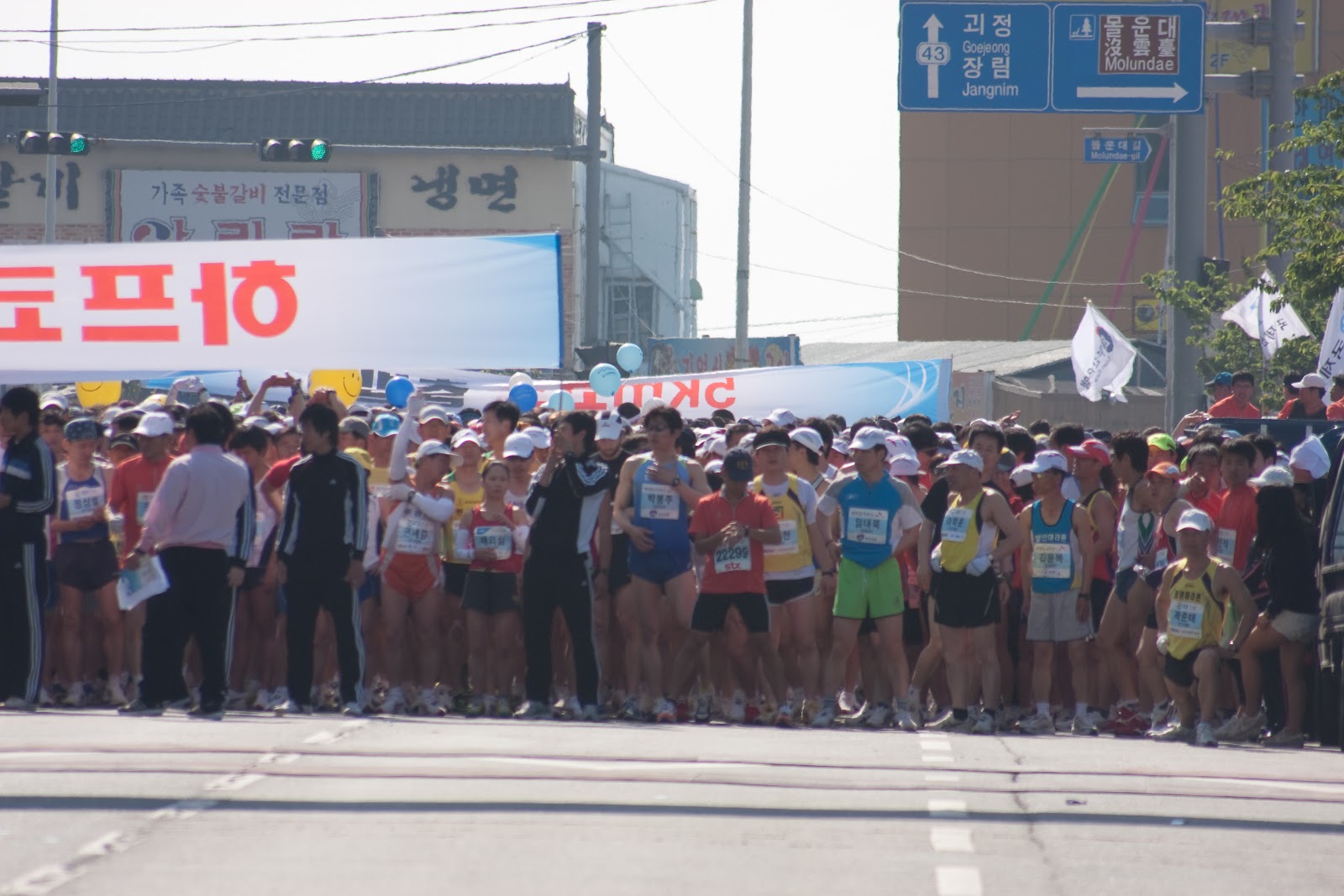
Race #22299. The Dadaepo course was flat, but windy and cool at the start.. later becoming hot, but nothing compares to the humidity that Hong Kong serves. It is a good flat race to run including helicoptor, ballons, band, pacers, and fireworks all at the start. Actually, this is the first race I ran outside of Hong Kong without the humidity. It was very pleasant.


I just bought the Polar RS800CX, here are the times

Km Time        Split           Temperature

1.    0:03:39.7 0:03:39.7 - 23C
This time is quite fast but I see already that this watch isn't precise. No GPS watch is although it was holding up compared to my old Garmin 405CX. A big problem at the start was I didn't really know my new watch very well, so I was figuring when to press the button noticing that I fine tuned one of the settings preventing me from getting it to start. I went to "Free" mode and it was working (wheh).


Unfortnately, as I started to run after the sound of the gun, I was too concerned about the watch that I ran into an "official"; we collided and I bounced back. Unphased, I started my run again to a band, fireworks and helicopter! The wind from the helicopter made an extra "wall" to push through, but the intensity was exhilarting for everyone to quickly run through it.

2.    0:07:42.5 0:04:02.8 - 22C
3.    0:11:52.7 0:04:10.2 - 21C
4.    0:16:12.3 0:04:19.6 - 21C
5.    0:20:30.7 0:04:18.4 - 23C
5*   0:20:50.1
I am a big believer to run out quickly. It's the only way to get faster... Unfortunately, I felt I went to fast the first mile and wasn't able to break sub 20s.

6.    0:24:47.3 0:03:57.2 - 23C
7.    0:29:12.0 0:04:24.7 - 24C
8.    0:33:33.0 0:04:21.0 - 24C
9.    0:37:53.6 0:04:20.6 - 28C
10.  0:42:10.3 0:04:16.7 - 26C
10*. 0:42:46.8

I'm basically out on the bridge and the times are pretty stable. There were some ramps that I had to go up. I believe that the pace is decent and only 1 minute from my 10k PR.

11.   0:46:34.0 0:03:46.7 - 25C
12.   0:51:15.2 0:04:41.2 - 27C
13.   0:55:46.8 0:04:31.6 - 29C
14.  1:00:04.6 0:04:17.8 - 31C
15.  1:04:40.3 0:04:35.7 - 29C
15* 1:05:19.7

I was very happy to see 1 hour for 14km. Seldom in Hong Kong practice do I hit 13km for 1hour.

16   1:09:13.3 0:03:53.6 - 28C
17   1:13:53.3 0:04:40.0 - 28C
18   1:18:34.4 0:04:41.1 - 29C
19   1:23:19.5 0:04:45.1 - 29C
20   1:28:08.1 0:04:48.6 - 29C
21   1:32:50.4 0:04:42.3 - 29C

Being under sub 5minutes for the whole race certainly appears that my hill training is providing me endurance. In the Hong Kong Marathon, I hit 5's before the half way mark.
21.1* 1:34:19.4
Official Time: 1:34:22


Sunday, May 9, 2010

MacLehose Stage 3,4 [May 2/9] TrailRunning

Trail Running is a great way to quickly complete stages of the Hong Kong peaks and have enough time to do other things. Don't get me wrong, I think hiking is great as well to embrace the beauty. I'm just on a tight schedule. The first run was with the Hong Kong Hiking Meetup Group. It's a good mix of people because there are hikers, walkers, and runners. We did some 15 minutes of Tai Chi before starting stage 3. The trail is difficult; I believe Lantau and Sunset peaks are more difficult.


It's pretty much a "hike" going to the top, there are short distances to run but most of it is "short". Forget about running when it rains, it is quite dangerous from my experience. Once you hit the top, you head down and climb up all over again.


Stage 4 was only attempted on May 9th. The idea was to leave early and run stage 3 and meetup the "Meetup" group at stage 4. It didn't quite work that way. The terrain was very slippery and my running buddy got lost but was able to meet 10 minutes ahead of me at entrance of stage 4.

Stage 4 was muscle spam stage. I wasn't able to complete without stopping and stretching/resting. We were not able to catch the Meetup team because the fact that we got lost and I was just dead sore. It took 3 days to recover from my wounds.

Wednesday, May 5, 2010

Bloated

I must say overall except for an initial Iliotibial Band Syndrome - IT Band Syndrome, I've been pretty healthy. But, since I'm human... I will falter. And falter I did. CONSTIPATION. I'm not talking about the kind that once you get the big bullet out of your system, you're fine. I had one that just turns old men into children. It all started after my small 10k trail running out on MacLehose Trail - Stage 3 (Pak Tam Au). I went buffet style and I pigged out. Of course, no one else in my party had this problem! In the eveing, I even threw up after eating Ramen noodles. I thought it would be fine the next day - I was wrong... It seemed even worse. I couldn't even stand up at times. Finally I went to the doctor 2 days later and he gave me medication. I told him what I ate (as if he cared) and he just said it was indigestion. So, after analysing my eating habit - I would have to say that drinking lots of water (2-3 liters) is so important. I use to drink that much daily but, it's hard to consume... I think it was a virus though.

Friday, April 30, 2010

Proprioceptive training

I read this article and found it interesting:

Irregular and unpredictable surfaces often found on the trails can lead to ankle injury. Ankle instability can be prevented through the improvement of joint sensation, known as proprioception. Proprioception plays a key role in all activities, especially trail running, where the environment is open and running surfaces uneven. Current research suggests instability training has numerous benefits for your body and can significantly reduce the occurrence of ankle sprains.

Three methods and corresponding benefits of instability training are provided below and are sure to keep you continually active and less injury prone.

A recent study found that home-based proprioceptive training was significantly effective in preventing the recurrence of ankle sprains.

1. Training on uneven surfaces

Running on uneven surfaces increases the demand for stability. Your body meets this demand by using proprioception. The input for the body’s periphery that allows for this sensation to occur comes from tiny mechanoreceptors in muscles and ligaments, and receptors in the sole of the foot, which tell the body how fast and at what tension they are contracting or being stressed. Research has demonstrated that training these mechanoreceptors dynamically while trail running, running on sand, or barefoot on grass, will allow for more efficient sensory input and better performance.

2. Home-based proprioceptiptiptive training

A recent randomized study performed in Denmark and published in the British Medical Journal found that home-based proprioceptive training performed for twelve weeks was significantly effective in preventing the recurrence of ankle sprains. Increasing stability in joints such as your ankle can even refine your muscle reflex capabilities on uneven surfaces and decrease your chance of acute injury such as a joint sprain. This muscle reflex breakthrough, quantified by German biomechanists of the University of Münster, along with previously stated findings, concludes home-based proprioceptive and stability training will have an impact in improving runners’ trail performance, as well as decreasing injury.

Home-based proprioceptive training exercises
Short Foot Exercise
While standing barefoot, pretend you are at the beach and attempt to “draw sand” under the arch of your foot. This technique is a specific way to increase the proprioceptive influence by stimulating the receptors on the soles of the feet. Repeat the movement six to ten times.


One-Legged Rocker Board Perch
Perform exercise statically (standing as still as possible) with rocker board positioned to sway side to side, or forwards to backwards. In both positions make sure the axis of board tilt is directly below your ankle joints, as this joint will support your entire body. Stand with one leg at a time on the board with your body upright, hips and knees very slightly bent (similar to skiing), and try not to look down for increased difficulty. Start with a goal of thirty seconds in a stable perch per leg, and practice each leg (even if one is more proficient), alternating side to side, three times per exercise session. Close eyes to increase the demand for stability.


BOSU-Ball Lunges
Start with your BOSU ball in a stable position against a wall. Place the heel of your forward foot touching the centre of the ball with its flat side facing down. Your forward and rear knees should reach but not exceed ninety degrees during the test repetition or during your set. Now, facing the ball, lunge forward with your lead leg, focusing on your hips and ankle joints and staying as stable as possible. Perform alternating, slow lunges, making sure you push down through your lead heel on the way up on each repetition. This is a dynamic (movement) exercise but is only effective if performed slowly, focusing on decreasing body sway, and increasing body control. Perform twelve lunges with each leg and three to four sets each session.


3. Closing eyes to add difficiculty and further adaptatiation

Closing your eyes to increase stability components in your home and gym training program was recently proven effective by Australian strength and conditioning specialists examining postural sway in athletes with functional ankle instability. The research suggests closing your eyes while performing static proprioceptive training will increase the difficulty of the movement and improve joint proprioception. This technique will add difficulty for elite athletes, as well as beginners who are progressing quickly. There are many inputs that help provide information on balance, such as the inner-ear equilibrium, proprioceptors, and vision. Removing one of these inputs will cause the others to work harder and adapt. Closing the eyes is a great way to force increased reliance on the sensation an individual is attempting to improve.

Tuesday, April 27, 2010

Gold Standard 100% Whey

Although this is product is more geared toward body builders, I believe that it helps recovery from long or hard training runs where the microfibre muscles require repair. I drink 1-2 scoops of this 5-6 times a week. I like the chocolate mint; the rest is not tasty. Check out more information about why protein: http://www.bodybuilding.com/store/whey.html

Sunday, April 25, 2010

HKMP 4X Country + Road Race [0:47:35]

The 4th Shatin Mixed Terrain Race was held on Apr 25 (Sun) starting at 8:30am at the Siu Lek Yuen Village Car Park; distance is around 9km.


First and foremost: This race puts me over 1,007km since I started keeping stats.


Click below for:
Garmin Full Stats; Official Results

KmSplit min/km  min/mile +Elevation -Elevation
1            0:04:52 7:51         216                 0
At the starting line, all you could see was a big steep hilly road. Well, luckily the weather was great and cool especially for Hong Kong. I have to tell you I was surprised how fast the runners went out because I myself was under 5 minutes for around 100m elevation. I know the elevation say 216; but I don't believe it. I looked at google map and believe that more.

2            0:06:34 10:35       246                 0
This was all steps going up and up and up. I don't really like to stop running and walk; but this race is a must. You wonder if you are in shape? Well, try this course and you'll realize what your body can handle. For me, I thought the 2 peak hike/run last 2 weekends were enough. I was wrong!

3            0:09:05 14:38       271            -201
This path turned technically difficult because now it's not steps but you are running half of it downhill like leapfrog. I remember parts of it being dirt trails; flashback 20years when I did cross country.

4            0:05:11 8:20            0             -302
All down hill on road. Picking up speed...
5            0:03:44 6:00            0             -206
Unbelievable? I thought I could only do this on a flat first 1k. Thank you gravity!

6            0:04:17 6:54          12             -144
7            0:04:16 6:53          42             -18
8            0:04:22 7:02           7                0
9            0:04:20 6:58         42               -41
10          0:00:50 6:23           0               -12
The rest of the race was all flat; similar to Tolo 5k. I was happy with this pace especially after the brutal first 3k, but some girl just whizzed me by 200m ;( before the end. Good for her!

Summary 0:47:36 8:19 836 925
If you are planning to run or hike the Oxfam Trailwalker in November, Moontrekker in October, or Lantau 2 Peaks 20k race in October; then this race was a little taste of hill race running/hiking/walking.


My T-shirt